Introduction: What Does a Sustainable Wedding Really Mean?
Planning a sustainable wedding in Italy does not mean giving up beautiful details, following a particular “green” aesthetic or trying to create a celebration with no environmental impact at all. Every wedding uses resources, and this is especially true of a destination wedding.
For this reason, we believe it is more useful to think about sustainability not as a standard of perfection, but as a way of making more conscious decisions throughout the planning process. Instead of asking how to make every single element sustainable, couples can begin by identifying the choices that have the greatest impact and considering where a different approach might make sense. This could mean choosing a venue where guests can stay together, arranging shared transportation, designing a menu around seasonal ingredients, working with local professionals, renting rather than buying, or considering what will happen to flowers, food and decorative materials once the celebration is over.
Interestingly, many of these choices do more than reduce waste or unnecessary transportation. They can also make a destination wedding feel more deeply connected to Italy. A menu shaped by what is growing locally, flowers chosen according to the season, handmade objects created by artisans from the region and a venue whose existing architecture becomes part of the wedding design all give guests a stronger sense of where they are.
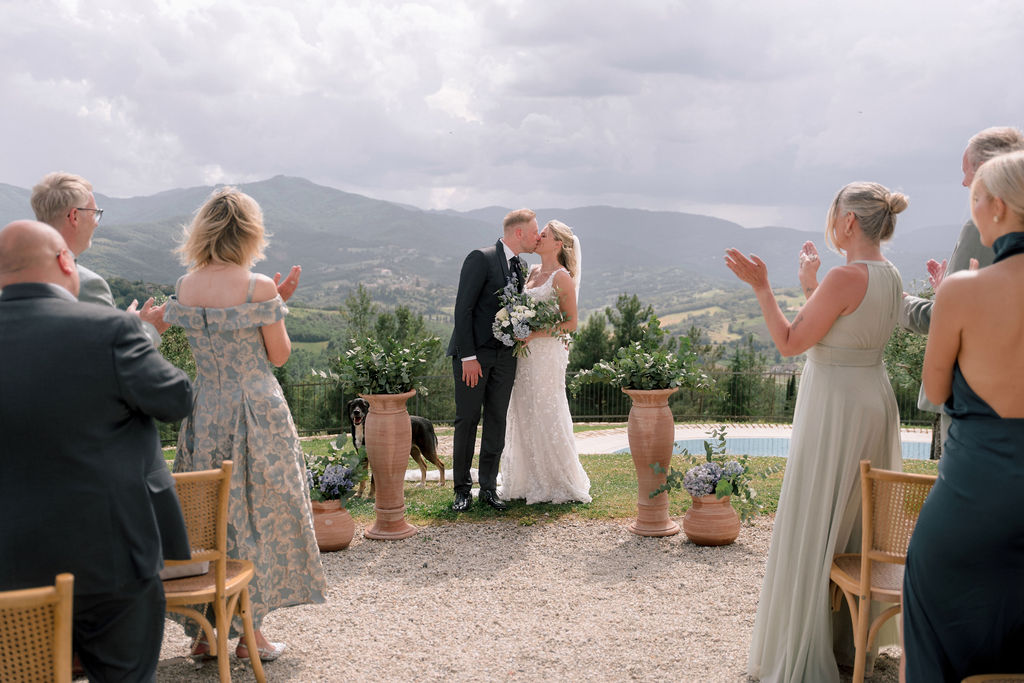
This is particularly relevant when planning a wedding in Tuscany or Umbria, where food, agriculture, craftsmanship, landscape and local traditions are still closely intertwined. Instead of bringing an entire wedding concept to Italy and recreating it within an Italian setting, sustainability offers couples an opportunity to reverse the process: to begin with the destination itself and allow it to influence the celebration.
Throughout this guide, we will explore how to plan a more sustainable destination wedding in Italy, looking at the decisions that matter from the earliest stages of planning through to the wedding weekend and beyond. There is no single formula and certainly no perfectly sustainable wedding. The aim is simply to understand the alternatives available and make thoughtful choices where they can make a difference.
1. Sustainable Destination Weddings: Start with the Choices That Matter Most
When couples begin researching how to plan an eco-friendly wedding, attention often turns first to the most visible details: recycled invitations, biodegradable confetti, seed-paper favours or reusable decorative elements. These can all contribute to a more thoughtful celebration, but they represent only one part of a much larger picture.
For a destination wedding, some of the most significant decisions are made much earlier. The location of the venue determines how guests and suppliers will travel; the availability of accommodation affects the number of transfers required throughout the weekend; the catering choices determine where ingredients come from and how food waste is managed; while the design of the event influences how much furniture, décor and floral material needs to be transported or produced specifically for the occasion.
Looking at sustainability from this wider perspective helps couples establish priorities. A recycled place card may be a lovely choice, for example, but coordinating shared transportation for dozens of guests instead of requiring everyone to travel separately can have a much broader effect. Similarly, choosing locally grown seasonal flowers may be more relevant than focusing exclusively on whether a small decorative element is biodegradable.
Acknowledging the Impact of a Destination Wedding
There is, of course, an important reality to acknowledge when discussing sustainability and destination weddings. For an international couple marrying in Italy, the celebration will often require guests to travel considerable distances, sometimes by air. Describing such an event as entirely sustainable would therefore be unrealistic, and we believe that recognising this contradiction is more useful than trying to avoid it.
Once the decision to marry in Italy has been made, however, there are still many opportunities to reduce unnecessary impact. None of these decisions removes the environmental impact of travelling to Italy, but together they create a more considered approach to what happens once everyone arrives.
Think Local Before Thinking “Green”
One of the most useful principles when planning a sustainable wedding in Italy is also one of the simplest: before searching for something labelled “eco-friendly”, look at what already exists close to the place where you are celebrating.
Italy has an extraordinary network of small farms, wineries, food producers, craftspeople and independent businesses whose work remains strongly connected to their territory. In Tuscany and Umbria in particular, it is still possible for many elements of a wedding to originate relatively close to the venue, from wine and olive oil to flowers, ceramics, textiles and handmade paper.
Choosing locally does not automatically make every product sustainable, of course, and distance is only one part of a much more complex picture. Nevertheless, sourcing closer to the wedding can reduce unnecessary transportation, support the communities hosting the celebration and, perhaps most importantly from an experiential perspective, give the wedding a character that could not simply be reproduced somewhere else.
2. Choosing a Sustainable Wedding Destination in Italy
Italy offers an extraordinary variety of settings for a destination wedding, but when sustainability becomes part of the planning process, choosing a destination involves more than finding a beautiful landscape. Accessibility, accommodation, local suppliers, seasonality and the distance between the different parts of the celebration can all influence the overall impact of the wedding.
This does not mean that couples should automatically avoid remote countryside locations. Some of the most beautiful wedding venues in Tuscany and Umbria are naturally found away from major cities, and their relationship with the surrounding landscape is precisely what makes them so special. What matters is understanding how the destination will work as a whole. A countryside estate that offers accommodation, catering and several spaces for different events may ultimately require fewer journeys than a more accessible venue that depends on hotels, restaurants and suppliers scattered across a wide area.
Accessibility should therefore be considered alongside the experience couples want to create. How far is the destination from an international airport or a well-connected railway station? Will most guests need to rent cars, or can group transfers be arranged? Are there enough accommodation options nearby? Can the welcome dinner, wedding and farewell brunch take place within the same area? Looking at these questions early in the planning process can help avoid a wedding weekend built around constant movement.

Sustainable Weddings in Tuscany and Umbria
For couples considering a sustainable wedding in Tuscany or Umbria, both regions offer an interesting combination of historic architecture, agriculture, craftsmanship and relatively small local communities. Vineyards, olive groves, farms and food producers remain an integral part of the landscape, while many wedding venues occupy historic buildings that have been restored and adapted rather than created specifically as event spaces.
This relationship with the territory creates opportunities to source many elements of a wedding locally, from wine and olive oil to seasonal ingredients, flowers, textiles and ceramics. It also makes it possible to build experiences around what already belongs to the destination: a wine tasting at a nearby vineyard, a welcome dinner based on regional dishes, a visit to a historic town or a morning spent discovering local food traditions can become part of the wedding weekend without requiring elaborate entertainment to be created from scratch.
A sustainable approach can therefore influence not only how the wedding is produced, but also how guests experience Italy. Instead of moving continuously between attractions or importing experiences that could take place anywhere, the destination itself becomes part of the program.
3. How to Choose an Eco-Conscious Wedding Venue in Italy
Once the destination has been chosen, the wedding venue becomes one of the decisions with the greatest influence on sustainability. Its location affects transportation, its facilities determine what needs to be brought in, and its architecture can influence how much temporary décor or infrastructure is required. For a destination wedding, accommodation and the possibility of hosting several events in the same place can make the venue even more significant.
An eco-conscious venue is not necessarily one that explicitly describes itself as sustainable. Environmental practices can take many forms, from renewable energy and water management to waste separation, locally sourced food, restoration of historic buildings and relationships with nearby producers. For this reason, it is useful to look beyond labels and understand how a property operates in practice.
Agriturismi and working estates can be particularly interesting in this respect, as some produce their own wine, olive oil, vegetables or other ingredients and maintain a close relationship with the surrounding agricultural landscape. Historic villas and castles offer a different kind of opportunity: existing architecture, gardens, courtyards and reception rooms can provide much of the character of the celebration without requiring extensive temporary installations.
Work with What the Venue Already Offers
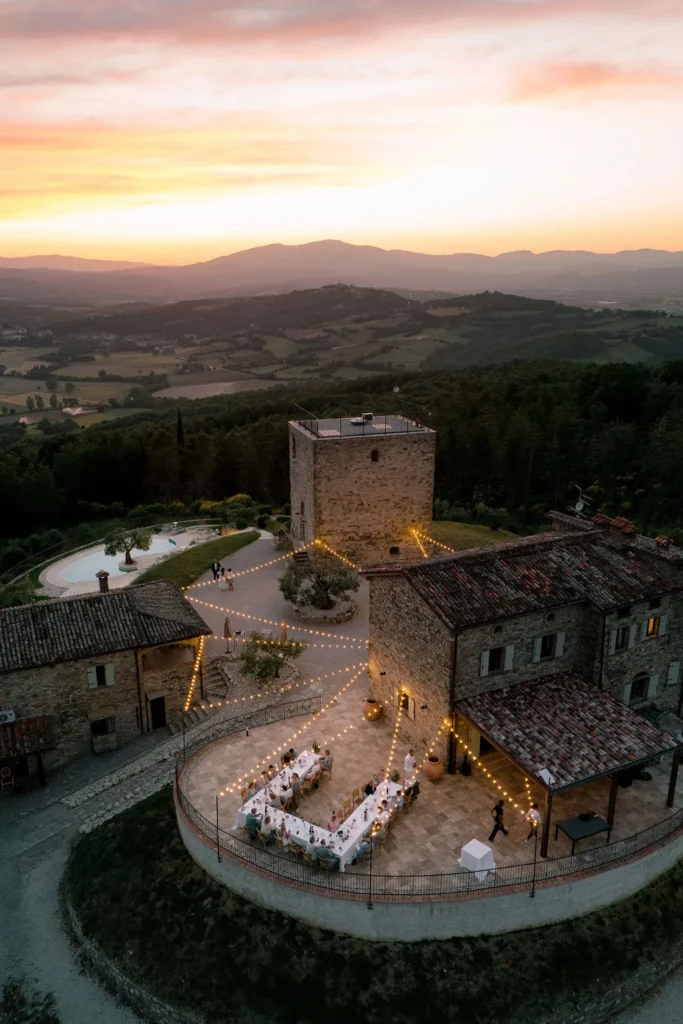
A venue that already reflects the atmosphere a couple wants to create can reduce the temptation to transform every space. A garden may provide a natural ceremony setting, a stone courtyard can host an aperitivo, while a terrace overlooking the countryside may need relatively little decoration to become a memorable dinner setting. Existing tables, chairs, lighting or decorative pieces can sometimes be incorporated into the design rather than automatically replaced.
This approach should not be confused with doing less for the sake of sustainability. Good wedding design is often about editing as much as adding: identifying what deserves emphasis, what the space already communicates and where additional elements will genuinely contribute to the experience.
The same thinking applies to the weather plan. A venue with attractive existing indoor spaces may avoid the need for temporary structures in case of rain, while a property with several usable areas can allow the wedding to move naturally from one moment to another without constructing entirely new environments for each stage of the day.

Questions to Ask a Sustainable Wedding Venue
A venue does not need to satisfy every possible sustainability criterion to be a good choice. Asking a few practical questions, however, can help couples understand where meaningful differences can be made:
- Does the venue use renewable energy or energy-saving systems?
- How does it manage recycling and organic waste?
- Does the property have measures in place to reduce water consumption?
- Can guests stay on site or within a short distance?
- Can several wedding events take place at the same property?
- Is there an existing indoor option for bad weather?
- Which furniture and equipment are already available?
- Does the kitchen source ingredients locally or seasonally?
- Does the property produce any wine, olive oil, vegetables or other food itself?
- Does the venue regularly work with professionals based in the surrounding area?
- Can group transportation such as coaches or minibuses easily reach the property?
The answers provide a much clearer picture than a sustainability label alone, and they can also help the couple and planner identify which aspects of the wedding deserve the most attention later in the planning process.
The Italian Village as a Wedding Venue
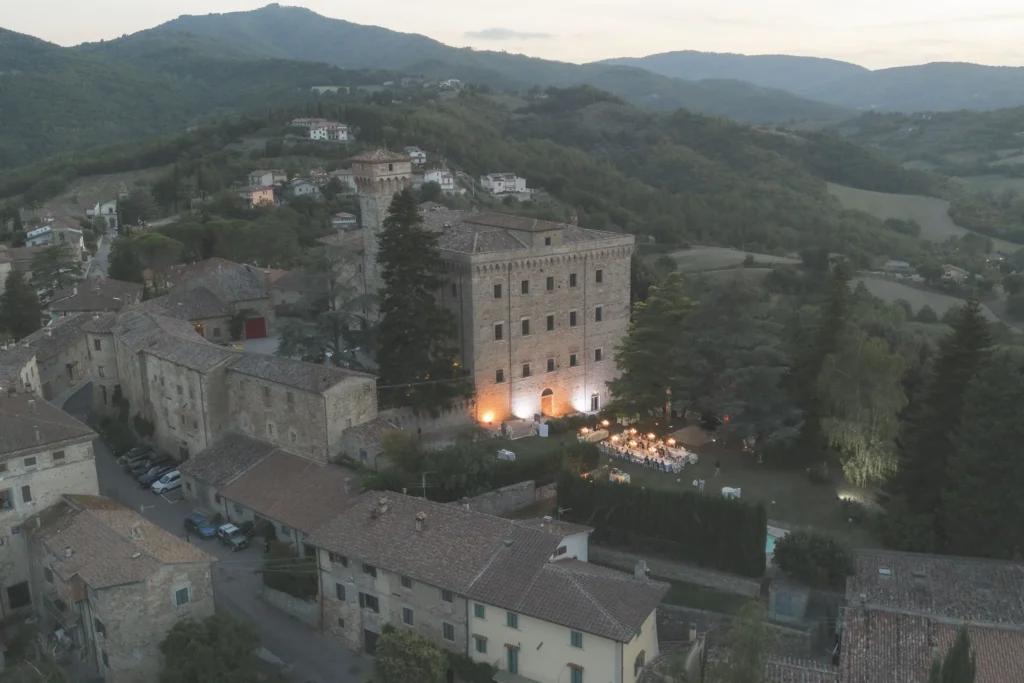
A sustainable approach to choosing a wedding venue does not necessarily mean finding a single property where everything takes place. In Italy, another possibility is to consider the village itself as part of the wedding venue, particularly in the small historic towns and borghi found throughout Tuscany and Umbria.
Rather than creating an entirely self-contained event, a wedding in an Italian village can make use of places and services that are already part of everyday local life. Guests might stay in small hotels, agriturismi or apartments within walking distance of one another, the ceremony could take place in the local church or town hall, and different moments of the celebration could unfold between a historic square, a garden, a restaurant or another existing space. When distances allow guests to move on foot and the logistics are carefully planned, this model can reduce the need to create temporary environments or transport everyone repeatedly between distant locations.
There is also a broader dimension of sustainability to consider. A wedding in an Italian borgo can involve local restaurants, accommodation providers, artisans, food producers and other small businesses, allowing part of the economic value generated by a destination wedding to remain within the community hosting it. For international guests, this can also create a very different relationship with the destination:
rather than experiencing Italy exclusively from inside a private property, they become part of the rhythm of a real place for a few days.
Of course, a village wedding is not inherently sustainable simply because it takes place in a historic town. Guest transport, accessibility, local regulations, noise restrictions, waste management and the availability of suitable accommodation all need to be considered carefully. The value of this approach lies instead in using existing places thoughtfully and involving the local community wherever it makes sense, rather than building an event around resources brought in exclusively for the wedding.
This way of celebrating is particularly close to our own experience in Tuscany and Umbria. Over the years, we have developed relationships with a selection of historic villages where the streets, piazzas, civic spaces and surrounding landscape can become part of the wedding itself. Places such as Anghiari, Citerna, Gualdo Cattaneo, Monte Santa Maria Tiberina, Monterchi and Montone each offer a different expression of this idea: not a conventional wedding venue enclosed within a single property, but a living Italian community that welcomes the celebration into its existing spaces.
For couples who have chosen Italy precisely because they want their guests to experience its culture and everyday life, this can be particularly special. The streets, piazzas, architecture and businesses of the village are no longer simply a picturesque backdrop; they become part of the experience itself. You can explore the Italian hamlets for weddings in Tuscany and Umbria that we know and love, and discover how each one offers a different way of experiencing a destination wedding in Italy.
4. Travel, Transport and Guest Accommodation
Travel is inevitably one of the most complex aspects of discussing sustainability in relation to a destination wedding in Italy. International guests may need to fly or travel long distances to attend, but once they arrive, thoughtful planning can avoid adding many unnecessary journeys to the experience.
One of the most effective approaches is to think about the geography of the wedding weekend as a whole. If guests are staying across several towns, the welcome event takes place in another location and the wedding venue is somewhere else again, transportation quickly becomes a major logistical operation. Concentrating accommodation and events within a smaller area can reduce those movements while making the weekend easier for everyone involved.
This is particularly important in rural Tuscany and Umbria, where distances that appear short on a map can involve winding country roads and longer travel times. Selecting one or two accommodation areas and arranging shared transportation can be much more practical than asking every guest to rent a car and navigate independently.
Shared Transport as Part of the Guest Experience
Coaches, minibuses and coordinated transfers are useful not only from a sustainability perspective. They can make the wedding considerably more comfortable for guests, who do not need to worry about parking, unfamiliar roads or driving back to their accommodation after the reception.
The same principle can be applied to arrivals and departures. When groups of guests are reaching the same airport or railway station at similar times, shared transfers may be possible, particularly for larger destination weddings. For smaller celebrations, clearly communicating train connections and recommended transport options can still help guests make informed decisions before they travel.
A well-organised wedding website becomes especially useful here. Alongside the usual information about dress code and schedule, it can include the nearest airports and railway stations, recommended accommodation areas, shared transfer details and practical guidance on whether guests genuinely need to hire a car. Providing clear information in advance makes the more efficient option easier to choose.
Consider the Wedding Weekend as One Journey
Multi-day destination weddings are sometimes assumed to be inherently more resource-intensive because they involve several events. In reality, much depends on how those events are designed. A welcome dinner, wedding and farewell brunch held within the same estate or small geographical area can require less movement than a single wedding day involving multiple distant locations.
The same suppliers may also be able to work across different moments of the weekend, while furniture, decorative pieces or floral elements can sometimes be reused or adapted rather than replaced for each event. This is where sustainability becomes part of the overall planning strategy rather than a collection of isolated choices.
For guests, the result can feel more cohesive as well. Instead of spending a significant part of their stay travelling between locations, they have more time to enjoy the place they came to Italy to experience. When logistics, hospitality and sustainability are considered together, the solution that reduces unnecessary movement is often also the one that creates a more relaxed destination wedding.
5. Sustainable Wedding Catering in Italy: Local, Seasonal and Plant-Based Choices
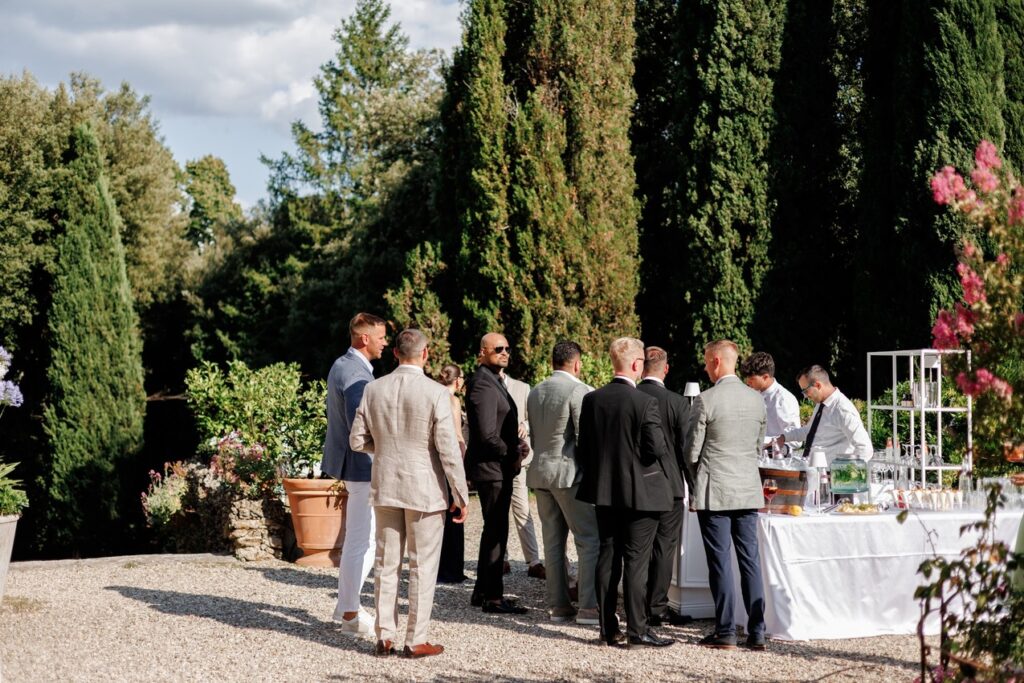
Food is at the heart of an Italian wedding, and it is also one of the areas where thoughtful choices can make a significant difference. Planning sustainable wedding catering in Italy does not necessarily require changing the dining experience completely or imposing restrictions on the menu. A more natural starting point is to look at what is produced locally, what is in season at the time of the wedding and how those ingredients can become part of the celebration.
This approach fits particularly well with Italian food culture. Regional cuisine has traditionally developed around seasonality, local agriculture and recipes shaped by what a particular territory could provide. Tuscany and Umbria are excellent examples: olive oil, vegetables, pulses, grains, cheeses, truffles, wines and many other ingredients are closely connected to specific landscapes and seasons. Building a wedding menu around them can reduce reliance on ingredients transported over long distances while giving international guests an opportunity to discover the destination through food.
Rather than starting with a predetermined idea of what a wedding menu should contain, couples can therefore ask their caterer what is at its best locally during the month of their celebration. The result may feel more Italian precisely because it responds to a particular place and moment, rather than reproducing the same menu regardless of whether the wedding takes place in May, August or October.

Local and Seasonal Does Not Mean Limited
There can sometimes be a perception that choosing seasonal ingredients means having fewer options. In reality, it can provide a much more interesting starting point for a menu, particularly in regions with strong agricultural traditions.
A summer wedding might celebrate tomatoes, fresh herbs and other seasonal vegetables, while an autumn menu could naturally move towards mushrooms, truffles, legumes and the flavours associated with the harvest. Local cheeses, extra virgin olive oil, bread and other regional products can become part of the experience too, allowing guests to taste ingredients that have a genuine relationship with the area they are visiting.
The same thinking can extend to drinks. Choosing wines from local or regional wineries, for example, introduces guests to another important expression of the territory. In Tuscany and Umbria, where vineyards form such an integral part of both the landscape and local culture, the wines served during the wedding can become part of the story of the destination rather than simply another item selected for the menu.
This does not mean that every ingredient needs to come from within a few kilometres of the venue. As with every aspect of sustainable wedding planning, the aim is not purity or perfection. It is about making local and seasonal sourcing the starting point whenever it makes sense, while asking more questions about where ingredients come from and choosing quality over unnecessary variety.

Vegetarian, Vegan and Plant-Based Wedding Menus
Reducing the amount of meat and animal products served can be another way to lower the environmental impact of a wedding menu, but vegetarian, vegan and plant-based food does not need to feel like a separate or lesser alternative. Italian cuisine already offers an enormous repertoire of dishes in which vegetables, grains, legumes and seasonal produce take centre stage, making it possible to create menus that feel naturally connected to the destination rather than built around substitutions.
Instead of approaching vegetarian or vegan dishes simply as alternatives to traditional courses, couples can work with their caterer to create options that stand on their own. A beautifully prepared vegetable antipasto, handmade pasta built around seasonal produce or a regional recipe that happens to be plant-based can sit naturally within the menu and be enjoyed by everyone, regardless of dietary preferences.
Some couples may choose to introduce more vegetarian or plant-based courses alongside meat or fish, while others may decide to make the entire celebration vegan. Both approaches can work beautifully within an Italian wedding, particularly when the focus remains on excellent ingredients, seasonality and the culinary traditions of the region.
For couples considering an entirely vegan celebration, we have explored the subject in much greater depth in our guide to planning a vegan destination wedding in Italy, covering not only catering and wine but also wedding attire, beauty, flowers and many of the other choices involved in creating a vegan wedding. It offers a more complete perspective on how vegan principles can extend beyond the menu and become part of the celebration as a whole.
6. Sustainable Wedding Flowers in Italy: Seasonal, Local and Thoughtfully Designed
Flowers are one of the most visible elements of a wedding, but their environmental impact is not always as easy to see. A floral arrangement may involve flowers grown far from the destination, refrigerated transportation, packaging and materials designed to be used only once. For couples planning a sustainable wedding in Italy, it is therefore worth looking beyond the finished arrangement and considering where flowers come from, how they are used and what happens to them afterwards.
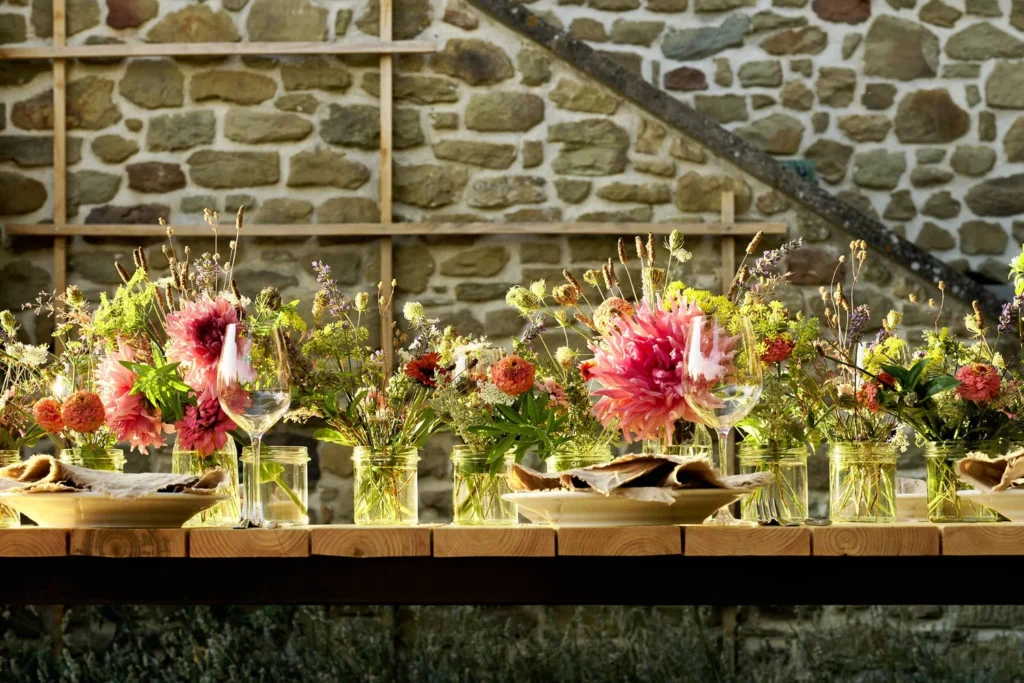
This does not mean that sustainable floral design needs to be minimal, rustic or less impressive. Abundant installations and sophisticated arrangements can still be created more consciously by working with seasonal flowers, sourcing locally where possible, choosing appropriate mechanics and designing arrangements that can have more than one purpose throughout the celebration.
Choose Seasonal and Locally Grown Flowers Where Possible
As with food, seasonality is a natural starting point. Rather than beginning with a fixed list of varieties that must be reproduced exactly, couples can share their preferred colours, textures and overall vision with their florist while leaving some flexibility around the flowers themselves. This gives the floral designer the opportunity to work with varieties that are naturally at their best around the wedding date.
For a wedding in Tuscany or Umbria, this can also create a stronger relationship with the surrounding landscape. Spring flowers, aromatic herbs, summer foliage, olive branches, grasses and autumnal textures can influence the design without necessarily making it rustic or overly botanical.
Of course, local does not automatically mean sustainable, nor does every flower need to be grown a few kilometres from the venue. Availability, weather and the requirements of the design all matter. The aim is simply to make seasonality and provenance part of the conversation rather than automatically requesting flowers that may need to travel much further.

Look Beyond the Flowers: How Floral Installations Are Built
Sustainable floral design also involves materials guests may never see. Large arrangements and installations require structures and mechanics, and some traditional methods rely heavily on single-use materials such as conventional floral foam.
Depending on the design, florists can work with reusable vessels, wire structures, pin holders and other alternatives. Not every technique is appropriate for every installation, so this is an area where professional expertise matters. Rather than prescribing a particular solution, couples can ask their florist which materials can be reused and where single-use mechanics can realistically be avoided.
A more responsible floral arrangement does not necessarily need to look different; often, the difference lies entirely in how it has been created.
Repurpose Flowers Throughout the Celebration
Another way to make better use of wedding flowers is to consider whether arrangements can serve more than one purpose. Ceremony flowers may later become part of the reception, while aisle arrangements can sometimes be moved to a bar, seating plan, staircase or another area.
Repurposing works best when it is planned from the beginning. Arrangements need to be designed so they can be moved safely, the timeline must allow enough time and the florist or planning team needs to know where each piece will go. Weather conditions also matter, particularly during hot Italian summers.
When the logistics allow it, the same flowers can accompany several moments of the wedding, rather than being created for a setting that guests experience only briefly.
Living Plants and Paper Flowers
Cut flowers are not the only option. Potted plants, aromatic herbs and other living elements can sometimes be incorporated naturally into the design and later replanted, reused or given to guests. Mediterranean plants such as rosemary or lavender can be particularly appropriate when they genuinely suit the setting and overall wedding aesthetic.
Another possibility is handmade paper flowers, used either on their own or alongside fresh flowers and foliage. Rather than simply imitating real flowers, they can become artisanal decorative pieces with their own texture and character. Their main advantage is longevity: they can move between different events, be reused after the wedding or kept as a lasting reminder of the celebration.
Paper itself is not automatically sustainable, so materials and production still matter. Flowers made from responsibly sourced, recycled or repurposed paper and created with a clear second life in mind offer a particularly interesting alternative. For a wedding in Italy, they can also introduce another element of local craftsmanship into the design.

What Happens to the Flowers After the Wedding?
The life of wedding flowers does not necessarily have to end with the reception. Depending on the arrangements and local possibilities, flowers may be taken home by guests, donated or composted, while containers and structures can be returned to the florist and reused.
These possibilities need to be discussed in advance. Donation requires a suitable recipient and transportation, while composting is only effective when flowers have been separated from wire, plastic and other non-compostable materials. Asking the florist and venue what can realistically happen after the wedding helps ensure that sustainability is considered across the entire life of the floral design, rather than only when choosing the flowers themselves.
For couples who would like to explore the subject in greater depth, our guide to wedding flowers in Italy looks more closely at seasonality, floral styles and the relationship between flowers, venue and wedding design.
Ultimately, sustainable wedding flowers are not defined by a particular aesthetic. They can be abundant or minimal, colourful or monochromatic, fresh, living or handmade. What matters is considering beauty alongside provenance, materials and longevity, creating a floral design that feels connected to both the wedding and the place in which it is celebrated.
7. Sustainable Wedding Design: Rent, Reuse and Work with the Setting
Wedding design is where a celebration becomes visually personal, but it can also involve bringing a large number of objects into a space for just a few hours. Furniture, tableware, textiles, lighting, signage and decorative structures all contribute to the atmosphere, so a sustainable wedding design begins by considering not only how they look, but also where they come from, how long they will be used and what will happen to them afterwards.
This does not mean creating a minimal wedding. It means designing with intention: working with what is already there, renting where possible and choosing elements that can be reused rather than treating every part of the wedding as something that needs to be created from scratch.
Let the Venue Be Part of the Design
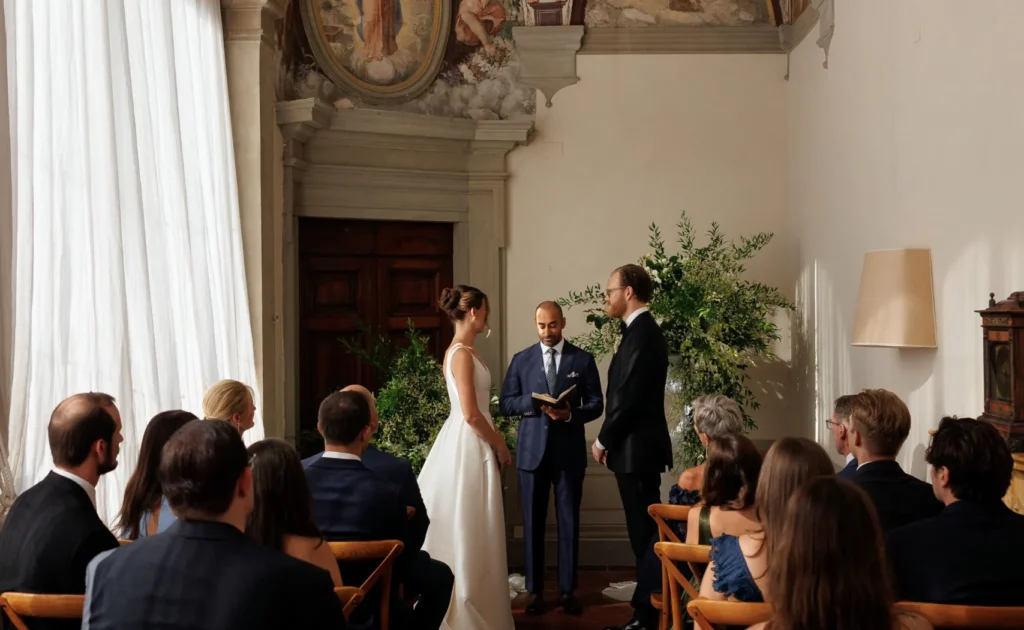
In Tuscany and Umbria, historic architecture, gardens, courtyards, olive groves and countryside views can already provide a strong visual identity. Rather than treating the venue as an empty canvas, the design can respond to its existing colours, textures and atmosphere.
A stone courtyard may already provide the perfect setting for an aperitivo, while a dinner table positioned towards a beautiful view may create more impact than an elaborate backdrop. The question is not how to decorate less, but where design genuinely adds something and where the setting already speaks for itself.
Rent Rather Than Buy
Rental is one of the simplest ways to reduce objects purchased for a single event. Tables, chairs, tableware, linens, candle holders, lounge furniture and many decorative structures can be used repeatedly across different weddings.
Working with local rental companies also encourages couples and designers to explore what is already available near the destination rather than reproducing every detail of an inspiration image. With thoughtful styling, rented pieces can still create a wedding that feels completely personal.
Design for Reuse, Not for a Single Moment
Repurposing can extend beyond flowers. Furniture and decorative structures can move between different events or spaces, while textiles and table accessories can appear throughout a multi-day celebration. Other pieces may be rented and returned, or chosen because they can become part of the couple’s home afterwards.
This approach also helps reduce single-use décor and inexpensive objects purchased simply for one moment. Not every detail needs a second life, but asking “what will happen to this after the wedding?” can be a useful filter when deciding what genuinely deserves a place in the design.
Sustainable Design Is About Intention, Not Less
A sustainable wedding can still be colourful, formal, romantic, contemporary or wonderfully abundant. Sustainability does not need to determine the aesthetic; it simply encourages greater consideration of how that aesthetic is created.
For a destination wedding in Italy, this can have an additional benefit. Bringing fewer unnecessary elements into the setting leaves more room for the architecture, landscape and character of the destination to become part of the design itself. It also opens the door to another important dimension of sustainability: choosing objects made locally and supporting the craftsmanship and skills of the communities where the wedding takes place.
8. Local Italian Craftsmanship: The Cultural Side of Sustainability
Sustainability is not only about reducing waste or environmental impact. It can also mean considering who makes the objects we choose, where they are produced and which skills our choices help to preserve. For a destination wedding in Italy, this opens up a particularly interesting connection with local craftsmanship.
Tuscany and Umbria have long traditions of ceramics, textiles, embroidery, handmade paper, woodworking and many other crafts. Incorporating these into a wedding can support small businesses and artisans while giving the celebration details that genuinely belong to the place where it is happening.

Choose Objects with a Story and a Future
Handmade ceramics can become part of a tablescape, locally woven linen can dress the table, while handmade paper or embroidery can appear in stationery and smaller decorative details. These pieces do not need to be used everywhere: even a few carefully chosen elements can introduce materials and techniques that connect the wedding to its destination. Our guide to the Italian wedding table explores this idea in more depth, looking at how tableware, textiles and local craftsmanship can help create a tablescape with a genuine sense of place.
Their value also lies in what happens beyond the celebration. A ceramic piece, embroidered textile or beautifully made object can be used again, given to guests or become part of the couple’s home. Longevity is an important part of sustainable design, particularly when it replaces objects made quickly and intended for a single use.
Supporting the People and Traditions Behind the Destination
Choosing local craftsmanship also brings another dimension to the idea of a sustainable wedding in Italy. Destination weddings contribute to the places that host them not only through venues and accommodation, but also through the network of small businesses and professionals involved in creating the celebration.
Working with artisans helps keep part of that value within the local community while supporting techniques and knowledge that have often been passed down through generations. In this sense, sustainability becomes cultural as well as environmental: it is about valuing not only the Italian landscape, but also the people and traditions that have shaped it.
This connection between weddings, craftsmanship and territory is also at the heart of our Artisans of Love project, dedicated to Italian makers and traditional crafts that can become part of a wedding in a contemporary and personal way.
A destination may provide the setting for a wedding, but locally made details can give it a much deeper sense of place. Rather than adding something simply because it looks Italian, craftsmanship allows couples to include something that was actually created there — by the hands, knowledge and traditions of the place they have chosen to celebrate in.
9. Sustainable Wedding Stationery: Print Less, Choose Better
Wedding stationery does not need to disappear from a sustainable wedding in Italy. Invitations, menus and place cards can be beautiful, tactile elements of the celebration and, in some cases, keepsakes. The aim is simply to distinguish between what benefits from being printed and what can be communicated more efficiently in other ways.
For a destination wedding, digital Save the Dates, online RSVPs and a wedding website are particularly useful for travel, accommodation and schedules, as this information may change throughout the planning process. QR codes can also connect a printed invitation or welcome piece to more detailed online information, avoiding the need for multiple inserts and additional printed materials.
For the elements that remain on paper, couples can consider recycled or responsibly sourced paper, handmade paper, local production and lower-impact printing techniques. Quantity is just as important: rather than creating a separate sign or card for every moment, a smaller number of thoughtfully designed pieces can often communicate everything guests need while becoming a more intentional part of the wedding design.
Sustainability therefore does not have to mean choosing digital over paper. It can simply mean printing with purpose: using digital communication where it works best and giving greater value to the physical pieces that remain.
For a deeper look at invitations, paper choices, menus, signage and sustainable alternatives, our Ultimate Guide to Wedding Stationery explores every element of wedding stationery in much greater detail.

10. Sustainable Wedding Fashion, Jewellery and Beauty
What couples wear on their wedding day can also become part of a more sustainable wedding in Italy. From choosing pre-loved garments to considering materials, provenance and local craftsmanship, there are many ways to approach fashion and beauty more consciously without allowing sustainability to dictate a particular style.
Wedding Attire: Think Beyond One Day
Choosing a more sustainable wedding dress or suit can take many forms. Vintage and pre-loved bridalwear, rental, garments made from deadstock or responsibly sourced fabrics, and pieces designed by local or independent makers can all offer alternatives to buying something newly produced for a single occasion.
Rewearing matters too. A suit, shoes or accessories that can become part of a wardrobe after the wedding naturally have a longer life, while an existing family garment can sometimes be altered or reinterpreted rather than replaced.

More Conscious Choices for Wedding Jewellery
Wedding jewellery offers several opportunities to make more conscious choices. Heirloom and vintage pieces can carry an existing story into the celebration, while family jewellery can be worn as it is or redesigned by a jeweller. For couples choosing something new, recycled precious metals, traceable stones and the work of local goldsmiths are all options worth exploring.
Wedding rings in particular invite couples to consider not only their design, but also the materials, provenance and craftsmanship behind them. In Italian Wedding Rings: A Circle of Tradition, Craftsmanship & Conscious Love, we explore this connection in greater depth, looking at Italian traditions, artisanal craftsmanship and more conscious approaches to choosing wedding rings.
As with sustainable fashion, there is no single material or choice that is automatically the “right” one. The value lies in understanding what you are choosing, how it was made and who made it.
A More Conscious Approach to Wedding Beauty
Wedding beauty can follow the same approach without becoming complicated. Working with hair and makeup professionals based near the wedding destination can reduce unnecessary supplier travel, while couples interested in the products themselves can explore cruelty-free, vegan, refillable or lower-waste alternatives.
For those who want to take this approach further, our guide to planning a vegan destination wedding in Italy explores vegan and cruelty-free wedding attire, shoes, accessories, hair and beauty in much greater detail.
Ultimately, sustainable fashion, jewellery and beauty are less about following a specific set of rules and more about looking at the story behind what you choose: whether something already exists, where it comes from, how it was produced and whether there is a more conscious alternative that still feels completely personal.
11. Sustainable Wedding Favours and Keepsakes: Local, Useful and Thoughtful
Wedding favours can be a beautiful way to leave guests with a memory of the celebration, but they can also become objects created specifically for the wedding with little purpose afterwards. A more sustainable approach starts by considering whether something will genuinely be used, enjoyed or kept, rather than choosing a favour simply because tradition suggests there should be one.
For a destination wedding in Italy, this can also be an opportunity to give guests something that carries a small part of the place they have travelled to experience.
Choose Something That Belongs to the Destination
Locally produced olive oil, honey, preserves or other regional specialities can make thoughtful favours while supporting producers from the surrounding area. Small handmade ceramics, textiles or other artisanal pieces can become lasting wedding keepsakes, particularly when they are useful rather than purely decorative.
Some keepsakes can even begin their life as part of the wedding itself. A handmade ceramic used on the table, a small embroidered textile or another carefully chosen detail can later be taken home and enjoyed again, giving the same object more than one purpose.
The value lies less in the size or cost of the gift than in its connection to the celebration. Something made or produced locally can remind guests not only of the wedding, but also of the flavours, materials and craftsmanship they discovered during their time in Italy.
Consider Experiences Instead of Objects
A favour does not necessarily have to be something guests take home. Particularly during a multi-day destination wedding, an experience can become the keepsake.
A wine or olive oil tasting, a visit to a local artisan, a cooking experience or a shared meal based on regional traditions can introduce guests to the destination while supporting the people who live and work there. Rather than producing another object specifically for the occasion, the couple is giving their guests an opportunity to experience something they might not otherwise have discovered.
Ultimately, sustainable wedding favours are not about finding the perfect “eco-friendly” product. Sometimes the right choice is something locally made and designed to last, sometimes it is something delicious that will be enjoyed, and sometimes the most lasting keepsake is not an object at all, but a memory of the place and the experience shared there.

12. Is a Sustainable Wedding in Italy More Expensive?
One of the most common assumptions about sustainable weddings is that they are either significantly more expensive or, at the opposite extreme, an opportunity to save money by simply having less. In reality, planning a sustainable wedding in Italy does not automatically mean spending more or spending less. It often means deciding differently where the budget goes.
Some sustainable choices can naturally reduce unnecessary costs. Working with seasonal flowers, renting rather than purchasing décor, using the existing character of a venue and avoiding elements that add little to the experience can all make the budget more efficient. Choosing local suppliers may also reduce certain transport and logistical costs, depending on the location and type of service involved.
Other choices may require a greater investment. Handmade objects produced by Italian artisans, responsibly sourced materials, ethical fashion or small-scale local production can cost more than mass-produced alternatives. This is not necessarily a disadvantage: part of a more conscious approach is recognising the real value of materials, craftsmanship and the people behind what we choose.
Spend Where It Matters Most
Perhaps the most useful way to think about sustainability and budget is therefore not in terms of saving, but of prioritising. Instead of spreading the budget across a large number of details, couples can decide which elements contribute to the experience and invest more thoughtfully in those.
For one wedding, that might mean an exceptional menu based on local ingredients; for another, handmade textiles or ceramics that become part of the tablescape. It could mean choosing shared transportation for guests, or investing in a venue where accommodation and several events can take place in the same location.
A sustainable wedding budget is not necessarily smaller. It is a budget in which couples understand why they are spending on something, where it comes from and what value it brings to the celebration. In many cases, that shift in perspective can lead not only to more responsible choices, but also to a wedding that feels more personal and considered.
13. Sustainable Wedding Checklist for Italy
There is no single formula for creating a sustainable wedding in Italy, and not every choice below will make sense for every celebration. Think of this checklist as a way to identify the areas where you can make more conscious decisions, rather than a list of requirements to fulfil.
Destination & Venue
- Choose a destination where accommodation, wedding spaces and local services are relatively close to one another.
- Consider venues where several moments of the wedding weekend can take place in the same location.
- Look at what the venue already offers before planning additional structures, furniture or décor.
- Ask about energy, water use, recycling, waste management and local sourcing.
- Consider an Italian borgo as part of the wedding setting, using existing spaces and involving local businesses where possible.
Travel & Accommodation
- Keep the geography of the wedding weekend as compact as possible.
- Arrange shared coaches or minibuses instead of relying entirely on individual cars.
- Group guest accommodation within the same area when possible.
- Use your wedding website to provide clear information about trains, airports, transfers and transport options.
Food & Drinks
- Build the menu around local and seasonal ingredients.
- Choose regional wines and products that reflect the destination.
- Include vegetarian, vegan or plant-based dishes as a genuine part of the menu.
- Plan quantities carefully with the caterer to reduce unnecessary food waste.
- Ask how leftover food and organic waste are managed.
Flowers
- Give your florist flexibility to work with seasonal and locally grown flowers where possible.
- Ask about reusable mechanics and alternatives to conventional floral foam.
- Plan from the beginning which arrangements can be repurposed during the celebration.
- Consider potted plants, herbs or handmade paper flowers where they suit the design.
- Discuss what will happen to flowers after the wedding.
Design, Décor & Stationery
- Rent furniture, tableware, textiles and decorative pieces rather than purchasing them for a single use.
- Allow the architecture and landscape of the venue to become part of the design.
- Choose elements that can be reused across different moments of the wedding.
- Avoid single-use décor where a reusable alternative makes sense.
- Use digital Save the Dates, RSVPs and practical guest information where appropriate.
- For printed stationery, consider recycled, responsibly sourced or handmade paper and print only what genuinely adds value.
Fashion, Jewellery & Beauty
- Explore vintage, pre-loved, rental or responsibly produced wedding attire.
- Consider whether clothing and accessories can be worn again.
- Look at heirloom jewellery, recycled precious metals, traceable stones and local craftsmanship.
- Work with local hair and makeup professionals where possible and explore cruelty-free, vegan or lower-waste products if these reflect your values.
Favours & Keepsakes
- Choose local, useful or consumable favours rather than objects guests are unlikely to keep.
- Consider handmade pieces that can become genuine keepsakes.
- Give existing wedding elements a second purpose where possible.
- Remember that an experience — a tasting, artisan visit or shared local tradition — can be a gift too.
And One Final Question
Before adding something to the wedding, ask:
Does this choice add real value to the experience, and is there a more thoughtful way to achieve it?
You will not always choose the most sustainable option, and you do not need to. A sustainable destination wedding is not created by completing every item on a checklist. It comes from making informed decisions, setting priorities and choosing more consciously where it genuinely makes sense.
Conclusion: A More Thoughtful Way to Celebrate in Italy
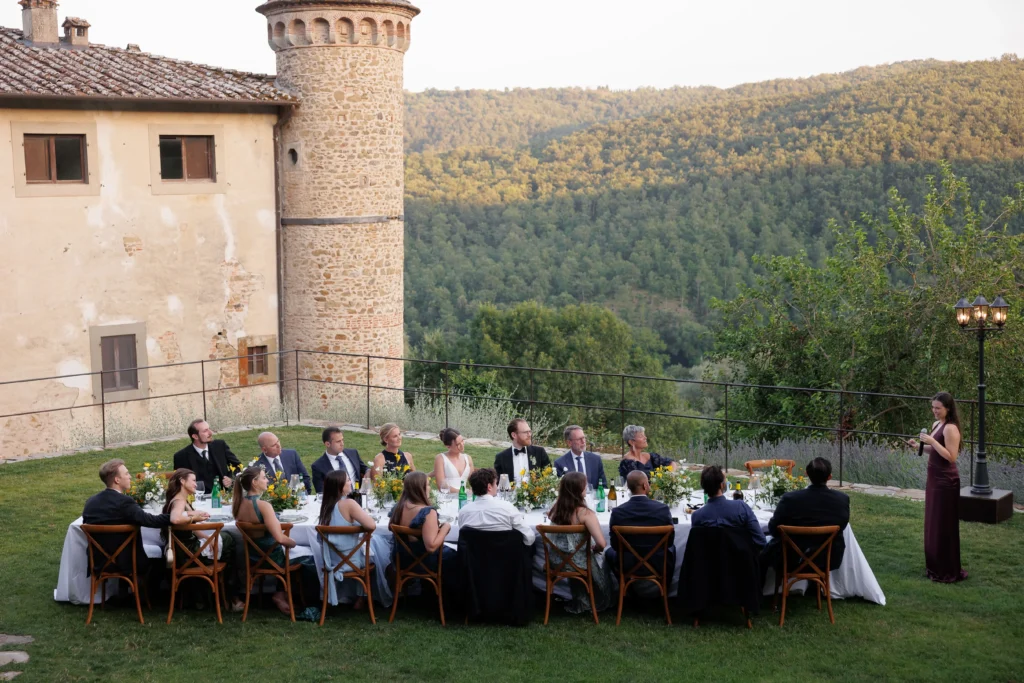
Planning a sustainable wedding in Italy is not about creating a perfectly low-impact celebration or measuring every decision against an impossible standard. A destination wedding will always involve travel, resources and choices that come with an environmental impact. What matters is becoming more aware of those choices and recognising where a different approach can genuinely make a difference.
Perhaps one of the most beautiful aspects of planning this way is that sustainability often brings couples closer to the destination they have chosen. Following the seasons means discovering what grows locally. Choosing nearby producers and artisans means encountering the people and traditions behind a place. Working with existing architecture and landscapes means allowing Italy to be more than a backdrop for the wedding.
In Tuscany and Umbria especially, where food, craftsmanship, agriculture, historic villages and landscapes remain so closely connected, there is already so much to work with. A wedding does not need to bring everything into a destination in order to make it extraordinary; sometimes the most distinctive celebrations are those that begin by looking at what is already there.
Ultimately, a more sustainable wedding is not defined by how many “green” choices appear on a checklist. It is shaped by curiosity, intention and a willingness to choose quality over excess, connection over convention and experiences that genuinely belong to the place.
And perhaps that is one of the most authentic ways to celebrate in Italy: bringing less to the destination, and allowing the destination to give more to the wedding.
GET IN TOUCH