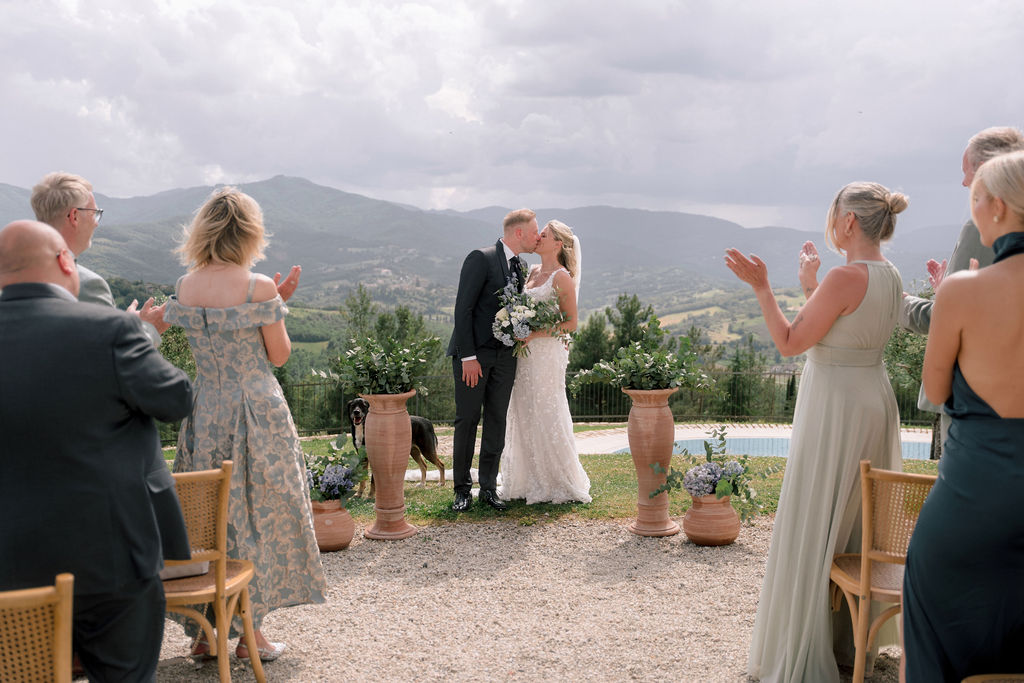
In 2026, the idea of a luxury destination wedding in Italy is evolving.
The shift is not from one day to several, but from intensity to intention.
Couples are rethinking how wedding time is designed—choosing celebrations that feel cohesive, emotionally balanced, and deeply considered. Rather than compressed timelines, the focus moves toward rhythm, care, and the quality of the shared experience. Here, luxury is not about excess or display, but about bespoke design, tailored pacing, and a level of care that feels natural rather than staged.
In Tuscany and Umbria, this approach feels instinctive. The landscape sets the rhythm, hospitality is deeply rooted, and beauty does not need to be amplified.

What’s changing in 2026: a more intentional approach to destination weddings
Across international wedding and travel trends, one evolution stands out clearly: celebrations are becoming experience-led, guest-centred, and deeply personal.
Personalized timelines replace the traditional wedding cadence
The rigid structure of the classic wedding day is giving way to tailored timelines, designed around emotional energy rather than inherited rules.
Couples are rethinking when things happen—and why. Quiet mornings, fewer rushed transitions, intimate moments before and after the ceremony. The result is a celebration that feels grounded and authentic, rather than performative.
In Italy, this approach works particularly well. The natural rhythm of the day—meals, light, temperature, landscape—supports a flow that feels human and unforced.
Multi-day weddings become curated journeys
Multi-day destination weddings are no longer about adding events. They are about creating coherence.
A wedding weekend is increasingly shaped as a journey with chapters: arrival, connection, celebration, and farewell. Each moment has space to breathe, and the experience as a whole feels intentional rather than compressed.
This is where a bespoke destination wedding truly takes form—not through quantity, but through continuity.
Guest experience becomes the true marker of refinement
In high-end celebrations, refinement is often invisible. It is felt through ease, comfort, and clarity.
Thoughtful logistics, intuitive timeline, and hospitality that anticipates needs without announcing itself are now central to how couples define an elevated wedding experience. When guests feel cared for, the atmosphere softens, conversation flows, presence replaces performance.
Wellness influences rhythm, not programming
Wellness, in its most refined expression, does not require schedules or instruction. It emerges through slower days, time in nature, better sleep, and gentler days.
In destination weddings, this translates into a restorative rhythm. Wellness becomes part of the atmosphere—woven into timing, food, light, and space—rather than an activity to attend.
Meaning takes precedence over maximalism
Many couples are choosing smaller, more curated guest lists to protect intimacy and connection. The emphasis shifts from visibility to depth, from display to experience.
This is where the modern idea of luxury still applies—but differently. It lives in privacy, intention, and authenticity, rather than scale.

The Italian advantage: a natural setting for intentional wedding weekends
Some destinations impress, others hold you.
Tuscany and Umbria offer a rare balance of beauty and grounding. Here, refinement is embedded in everyday life: in long meals that invite conversation, in craftsmanship that carries history, in landscapes that naturally slow the pace.
A tailored wedding weekend in central Italy often feels less like an event and more like a shared retreat. Hospitality is generous rather than formal, elegance is understated, the environment does not compete for attention—it supports presence.
Planning in this context is less about adding and more about protecting atmosphere: allowing time to stretch, moments to settle, and relationships to deepen.

The 3–4 day Italy wedding weekend blueprint
A well-designed wedding weekend follows a human rhythm. Enough structure to feel held, enough freedom to feel natural.
Day 1: Arrival and welcome — connection, not performance
The first day sets the emotional tone. Guests arrive carrying travel, transitions, and expectations. The most refined choice is simplicity.
A welcome moment works best when it feels warm and unforced: soft light, comfortable seating, familiar food, and spaces that encourage conversation without pressure. This is where guests begin to feel part of a shared world.
Day 2: “The Italy day” — a shared experience that sets the tone
The second day of the wedding weekend is shaped around a carefully curated shared experience, lived by all guests together. Its role is subtle but essential: creating connection, shared references, and a sense of cohesion within the group.
Through setting, rhythm, and attention to detail, this moment introduces the atmosphere of the wedding. By the time the celebration begins, guests already move within the same mood—grounded, connected, and attuned to what is to come.
Day 3: The wedding day — emotional pacing and shared moments
The most memorable wedding days are often the calmest.
Designing the day around emotional flow means allowing stillness before the ceremony, offering a few private moments afterwards, and creating transitions that feel effortless. The beauty lies not only in what happens, but in how it unfolds.
This is where a truly bespoke wedding design is felt most clearly.
Day 4: Farewell brunch and soft landing
A gentle ending completes the journey.
A relaxed farewell—late enough to respect recovery, informal enough to feel unstructured—allows conversations to linger and memories to settle. The weekend closes with the same care with which it began.

Experience elements that define a truly refined wedding weekend
In a bespoke wedding weekend, experiences are not added to fill time. They are chosen to shape atmosphere, connection, and memory.
What matters is intention: each element should feel inevitable, as if it naturally belongs to that place, that group of people, and that specific moment.
Curated tastings as moments of storytelling
A wine or olive oil tasting becomes meaningful when treated as a narrative rather than an activity.
It is not about technical explanation, but about discovering a landscape through flavour, rhythm, and shared attention. These moments often create a common language among guests and quietly anchor the weekend in its territory.
Encounters with local craft as cultural connection
Meeting artisans—through paper, ceramics, textiles, or other forms of craftsmanship—offers guests a deeper relationship with place.
These encounters are not decorative; they are cultural. They reveal time, knowledge, and continuity, resonating especially with couples who value authenticity over spectacle.
Slow mornings as part of the design
Late breakfasts, unhurried coffee, shaded outdoor spaces, and time without agenda are not empty moments.
They are where guests truly arrive—emotionally and physically. Designing space for rest is one of the most refined gestures a wedding weekend can offer.
Comfort as an invisible form of elegance
True refinement is often felt rather than seen. Thoughtful timing, protection from heat, easy movement between spaces, and intuitive logistics allow guests to relax and remain present. When comfort is handled quietly, the entire celebration feels lighter and more generous.
A ceremony atmosphere shaped by privacy
Regardless of guest count, intimacy can be designed.
Through layout, sound, timing, and spatial choices, the ceremony can feel and inward-looking, allowing emotion to take precedence over performance.
Food as a rhythm for connection
Rather than overwhelming guests, dining moments should support conversation and flow.
Meals designed with pacing in mind—courses that invite pauses, shared tables that encourage interaction—become one of the strongest tools for building connection throughout the weekend.
Space for the landscape to speak
A refined wedding weekend always leaves room for stillness.
A pause built into the day simply to look, breathe, and absorb the surroundings allows the place itself to become part of the memory, without explanation or staging.

What to avoid if you want the weekend to feel authentic
A wedding weekend loses elegance when it starts performing the destination instead of living it.
Over-programming creates fatigue rather than refinement.
Surface-level clichés weaken authenticity.
Too many locations disrupt atmosphere.
Ignoring climate and natural light undermines guest comfort.
The guiding principle is rhythm. When rhythm is respected, everything else finds its place.
Frequently asked questions about wedding weekends in Italy
What is a wedding weekend in Italy?
A wedding weekend in Italy is a multi-day celebration, typically lasting three to four days, designed as a shared journey that includes arrival, time to connect with the destination, the wedding day, and a relaxed farewell.
How do you keep guests engaged without constant entertainment?
By designing comfortable spaces, thoughtful rhythm, and a few anchor moments. When guests feel at ease, connection happens naturally.
Is a multi-day wedding always more expensive?
Not necessarily. Many couples invest in hospitality and experience rather than spectacle, creating a celebration that feels richer without becoming excessive.
What does “luxury” really mean in weddings today?
Today, luxury is best understood as privacy, intention, and care—a celebration designed to feel personal, human, and quietly memorable.
Conclusion
A destination wedding in Italy in 2026 is no longer about fitting into a predefined idea of what a wedding should be. It is about designing time with intention, creating space for genuine connection, and allowing a place to shape the experience rather than compete with it.
In Tuscany and Umbria, this approach feels especially natural. The rhythm of the landscape, the culture of hospitality, and the depth of local tradition offer everything needed for a celebration that feels private, considered, and deeply human. When a wedding weekend is thoughtfully designed, it becomes a shared journey—one that guests remember not for its scale, but for how it made them feel.
At Romantica Italia, this philosophy has always guided our work. We believe the most beautiful celebrations are shaped intentionally, with sensitivity to people, place, and time. Our role is not to impose a vision, but to listen carefully and translate it into an experience that feels effortless, coherent, and true to those who live it.
Because when a wedding is designed with this level of care, it doesn’t need to declare itself as “luxury”. It simply feels right.
GET IN TOUCH