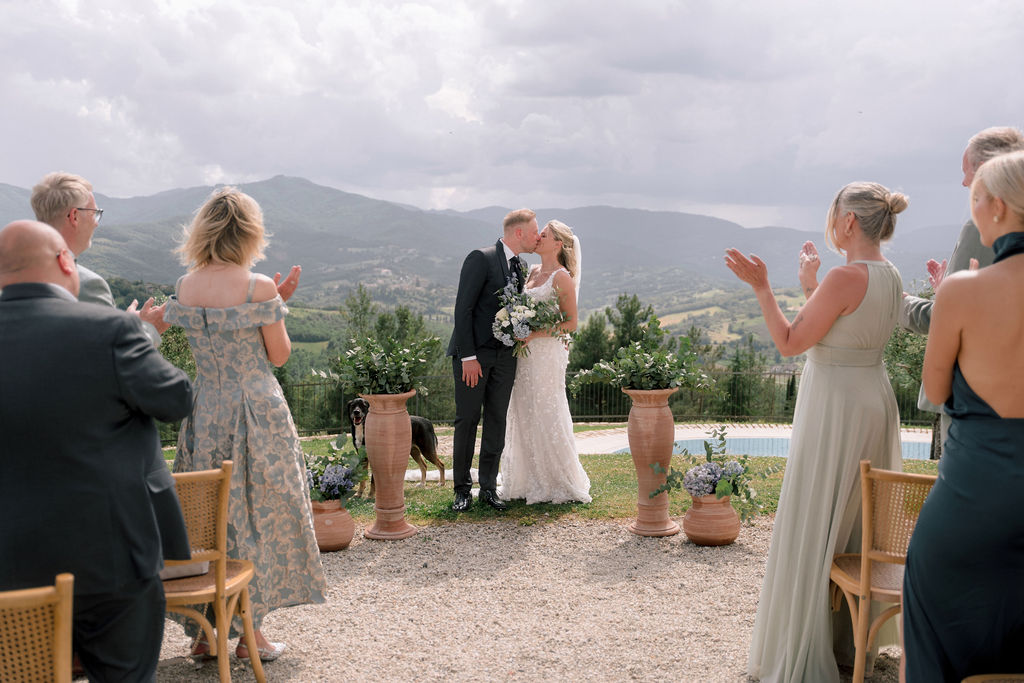
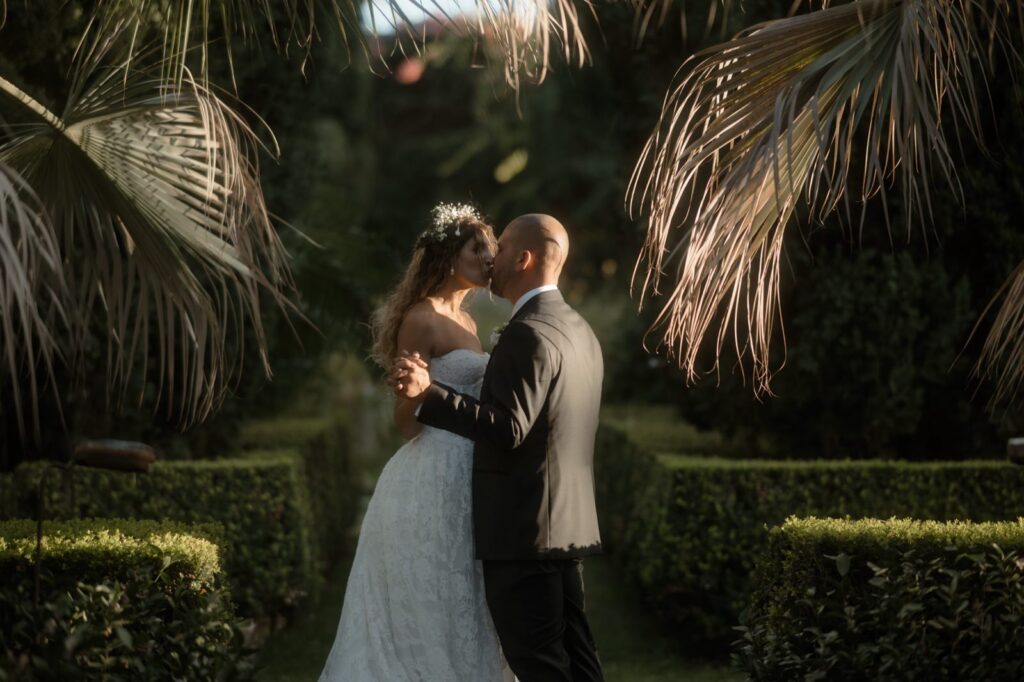
For couples planning a destination wedding in Tuscany or Umbria, choosing Italian wedding rings is not just a practical step. It is part of the cultural journey that leads to the ceremony itself.
In Italy, the wedding ring — traditionally known as the fede nuziale — represents devotion, continuity, and shared responsibility. It is simple in form, yet deeply rooted in history. Generations before us have exchanged the same circle of gold, carrying forward a tradition that connects families, faith, and community. Selecting your wedding rings in Italy can therefore become more than a purchase. It can become a way of grounding your marriage in the place where you choose to say your vows.
The symbolism of the wedding band in Italian culture
The wedding band is one of the oldest symbols of union. Its circular shape — without beginning or end — represents eternity. In Italian culture, this idea is closely tied to the concept of stability and family continuity.
Traditionally, Italian couples have chosen simple yellow gold wedding rings. While contemporary styles now include white gold, platinum, or mixed metals, the classic gold band remains the most recognized expression of marriage in Italy. Gold symbolizes durability and constancy — two qualities that have long been associated with a lasting union.
Unlike engagement rings, which often highlight a central stone, Italian wedding rings tend to favor proportion and balance over ornament. The emphasis is on the integrity of the metal, the comfort of the band, and its presence over time.
There is also a cultural detail that many international couples appreciate discovering. In Italy, the ring is typically worn on the left hand, linked to the ancient belief in the vena amoris, the vein said to connect directly to the heart. Whether legend or not, the gesture has remained part of the tradition for centuries.
For destination and international couples, understanding this cultural context transforms the ring from a simple design choice into something far deeper. The band becomes part of a wider story — one that continues long after the wedding day and anchors your personal love story to the place where your vows are spoken.
The ring exchange: a universal moment of promise
Regardless of the type of ceremony — civil, symbolic, or religious — the exchange of wedding rings is often the emotional center of the celebration.
It is the moment when words take form. The vows are spoken, and then they are sealed. The ring becomes the physical expression of what has just been promised.
In this sense, wedding rings are not decorative elements. They are the visible embodiment of the vows themselves. When placed on the hand, they transform intention into commitment.
For this reason, the moment should never be rushed or treated as a simple step within the ceremony. It deserves attention and coherence with everything that surrounds it.
When planning a destination wedding in Italy, it is also important to remember that every couple brings their own cultural background and traditions. In some countries, rings are worn on the right hand. In others, additional symbolic gestures accompany the exchange. Some couples choose to speak personal vows; others follow a traditional formula.
All these elements should be considered when designing the ceremony. The exchange of wedding rings in Italy does not need to follow one rigid script. Instead, it should reflect the couple’s identity while remaining in harmony with the setting and the overall tone of the celebration.
The atmosphere of the space, the way the couple stands facing each other, the rhythm of the ceremony, and even how the rings are passed into their hands all shape the experience.
When vows and rings are aligned in intention and atmosphere, the exchange gains depth. It does not need embellishment. It needs presence.
In Tuscany or Umbria, the landscape naturally frames the ceremony. Yet it is the care invested in shaping this moment that allows the exchange to feel authentic — not staged, but fully experienced.

Italian goldsmithing heritage: where craft becomes legacy
Italy’s reputation for fine goldsmithing is not recent. It is rooted in centuries of technical knowledge, aesthetic sensitivity, and disciplined craftsmanship.
In Tuscany, cities such as Florence and Arezzo have long been associated with the art of working gold. From the refined metal techniques of the Etruscans to the Renaissance workshops that shaped European decorative arts, the making of jewelry has always been part of the region’s cultural identity.
This heritage continues today, especially in the creation of handmade wedding rings.
Unlike industrial production, artisan goldsmithing involves a direct relationship between material and maker. The gold is shaped, curved, and refined by hand. The internal comfort fit is adjusted with precision. The surface is finished according to the intended texture — polished, brushed, satin, or lightly hammered. These are not anonymous objects.
A handcrafted wedding band carries subtle variations. The pressure of the tools, the way the metal responds, the final polish — each step leaves a trace. Even when two rings are designed as a pair, they will never be perfectly identical. That is precisely their value.
Italian artisan wedding rings are unique. They are not reproduced in series. They are formed once, for two specific people, at a specific moment in time.
For destination couples, this aspect can become part of the narrative. The rings are not only exchanged in Italy; they are shaped within a territory known for its goldsmithing tradition. The material, the craft, and the setting align.
Choosing handmade Italian wedding rings is therefore not about exclusivity in a commercial sense. It is about wearing something that cannot be replicated. A piece that carries history, skill, and human intention within its form.
This philosophy of craftsmanship is the same approach we celebrate through our Artisans of Love, a curated network of local makers who preserve traditional skills while working with contemporary couples.
And in today’s context, this reflection naturally leads to another important dimension — how the gold itself is sourced and how contemporary couples are redefining responsibility in their choices.

Photo credits: Marina Calamai
Sustainable & ethical wedding rings: choosing with intention
In recent years, many couples have started to look at wedding rings through a wider lens. Beyond design and craftsmanship, they are asking where the materials come from, how they are sourced, and who is behind their creation.
Gold mining, when not responsibly managed, can have a significant environmental and social impact. For this reason, one of the most concrete alternatives today is the use of recycled gold.
Recycled gold is not a lower-quality material, it is gold that has already been extracted, refined, and then re-melted for a new purpose. Because gold can be reused without losing its properties, this process reduces the need for additional mining while maintaining the same purity and durability as newly mined gold.
Many artisans in Italy now work with certified recycled metals or collaborate with suppliers who follow responsible sourcing standards. Organizations such as the Responsible Jewellery Council (RJC) and initiatives like Fairmined gold aim to improve transparency and ethical practices within the jewelry industry. While not every workshop carries formal certification, awareness around sourcing has grown significantly.
When gemstones are involved, some couples consider lab-grown diamonds, which have the same physical and chemical properties as mined stones but are created in controlled environments, reducing the environmental impact linked to extraction.
Yet sustainability does not end with materials. There is also a social and economic dimension to consider. Choosing handmade wedding rings from small Italian workshops supports a production model based on skill, time, and direct human involvement. It sustains local economies and helps preserve techniques that have been transmitted across generations.
Small-scale goldsmithing relies on knowledge that cannot be automated. When couples decide to commission or purchase artisan rings, they are not only selecting a product. They are contributing to the continuity of a craft tradition that might otherwise struggle in a market dominated by large-scale industrial production.
This form of sustainability is often less visible, but equally important. It protects cultural heritage. It values quality over volume. It keeps expertise alive.
For destination couples, this perspective often aligns naturally with the broader vision of their celebration. A wedding rooted in place — in landscape, architecture, and local culture — finds coherence in rings shaped by the same territory.
Sustainability often influences other elements of the wedding as well, from floral design to catering choices.
Selecting sustainable wedding rings in Italy therefore becomes an intentional act. It reflects environmental awareness, yes — but also respect for people, skills, and long-term value. And in marriage, choosing something built to last — materially and culturally — carries its own form of responsibility.

Designing the ring moment: aesthetic and practical details
Once the wedding rings have been chosen, there is another aspect that deserves thoughtful consideration: how they are presented during the ceremony.
The exchange may last only a short time, yet it stands at the center of the vows. For this reason, every detail surrounding the rings should be designed in harmony with the overall atmosphere of the celebration.
In Tuscany, couples often choose materials that reflect the rural landscape — a small olive wood ring box, a refined linen pouch, or a velvet case that echoes the interiors of historic villas.
In Umbria, where ceramic traditions are still alive, a handcrafted ring holder inspired by the decorative heritage of towns such as Deruta can create a subtle connection with the region. The hand-painted surface and slight irregularities of the glaze remind us that the object has been shaped by human hands.
Textile traditions offer further possibilities. A ring cushion made with handcrafted lace created using the tombolo technique, practiced in parts of central Italy, introduces a delicate and tactile dimension to the exchange. The intricate pattern, built thread by thread, reflects patience and skill — qualities that resonate naturally with the symbolism of marriage.
Similarly, cushions or pouches made from artisan-woven fabrics or embroidered linens can carry forward local craftsmanship. These are not generic decorative elements. They are pieces that embody time, expertise, and continuity.
The choice does not need to be elaborate. It needs to feel coherent with the ceremony setting and with the couple’s sensibility.
It is also important to consider who will carry the rings and how they will be introduced. Some couples involve a child from the family; others prefer a direct exchange between partners. What matters is clarity and preparation, so that the moment unfolds without interruption.
From a planning perspective, positioning and accessibility should never be overlooked. The couple should be able to move comfortably, and the rings should be easy to retrieve without disrupting the flow of the vows.
During a destination wedding in Tuscany or Umbria, these elements are coordinated alongside floral design, seating layout, and other curated details such as personalized wedding stationery.
The focus is not on emphasizing the moment, but on creating the right conditions for it to feel authentic.
When presentation, craftsmanship, and gesture are aligned, the exchange of Italian wedding rings becomes seamlessly integrated into the ceremony — supported by the same artisanal culture that shapes the wider celebration.

Engraving & personalization: adding an intimate touch
If craftsmanship gives Italian wedding rings their uniqueness, engraving gives them intimacy.
A handmade band is already one of a kind. The slight variations in shape, weight, and finish ensure that no two rings are ever truly identical. Yet this uniqueness remains aesthetic and material. The engraving adds something different — it connects the ring directly to the couple who wear it.
In the context of marriage, engraving is more than an optional detail, it is a tradition that completes the ring. Without it, something often feels unfinished.
Most couples choose to engrave their names and the date of the wedding, a simple and timeless decision that anchors the ring to a precise moment in time. Others prefer a short sentence, sometimes in their own language, sometimes in Italian.
For destination weddings, another discreet option is engraving the coordinates of the ceremony location, allowing the place itself to remain part of the story, even when the couple returns home.
What makes engraving powerful is its privacy. It is not visible to guests. It does not alter the external design. It is discovered only when the ring is removed, or when the two partners choose to share it. In this way, the inscription transforms an already unique object into something that belongs exclusively to those two people.
From a practical perspective, engraving should be planned in advance, especially when commissioning handmade wedding rings in Italy, as it requires time and precision. Discussing the wording carefully ensures that the choice feels considered rather than improvised.
When craftsmanship and personalization meet, the result is a ring that is both rooted in tradition and deeply individual. It carries the heritage of Italian goldsmithing on the outside, and the couple’s private promise within.
Timing and planning suggestions
When working with an artisan, timing becomes an important factor. Unlike ready-made rings, handmade wedding rings in Italy require planning. From the initial consultation to the final polishing and engraving, the process can take anywhere from four to eight weeks, depending on the complexity of the design and the availability of materials.
For destination couples, this can be beautifully integrated into the planning journey. If a site inspection is already scheduled — perhaps to visit the venue, attend a menu tasting, or meet the hair and makeup team — arranging an appointment with the goldsmith during the same trip allows the couple to experience the selection in person. Trying on different band widths, finishes, and weights often makes the decision clearer and more confident.
When travel is not possible, many Italian artisans now offer remote consultations through video calls, detailed photographs, and sample shipments for sizing. Technology allows the process to remain precise and personal, even from abroad.
Ideally, wedding rings should be commissioned at least three to four months before the wedding date, especially if engraving or custom design is involved. This ensures enough time for production, adjustments, and secure delivery without adding unnecessary pressure close to the ceremony.

Conclusion
A wedding ring is a simple object, yet it carries weight far beyond its material.
In Italy, the tradition of exchanging wedding rings is rooted in continuity, craftsmanship, and shared responsibility. From the symbolism of the gold band to the care invested in designing the ring exchange, every element contributes to a gesture that is both personal and enduring.
Choosing Italian wedding rings means more than selecting a design. It involves understanding the heritage behind the craft, considering the origin of the materials, and shaping a moment that reflects the couple’s values. Whether through handmade wedding bands crafted in Tuscany, sustainable sourcing, or a private engraving hidden inside the band, each decision becomes part of a coherent vision.
For destination couples, the rings often remain the most lasting connection to the place where their vows were spoken. Long after the celebration has ended, the circle remains — worn daily, shaped by time, and anchored in memory.
At Romantica Italia, we guide international couples through this journey with care and cultural awareness. Planning a destination wedding in Italy is not only about organizing an event; it is about making thoughtful, authentic choices that reflect sustainability, craftsmanship, and personal meaning.
When every element is chosen with intention, the result is not simply a beautiful wedding, but a celebration that feels aligned in every detail — including the circle that endures long after the day itself.
GET IN TOUCH