Getting married in Italy is an experience steeped in meaning — a blend of beauty, ritual, and elegance. Yet for many international grooms, understanding Italian wedding traditions can feel like stepping into a world of unspoken codes: the order of the procession, the role of the testimoni, the significance of bomboniere and confetti, or the right attire for a wedding in the different parts of Italy.
In truth, these customs aren’t about rules — they are gestures of respect, moments that connect your story to centuries of celebration. Every bow, every toast, every detail carries a certain poetry that makes an Italian wedding feel so effortlessly timeless.
This guide is a companion for the groom who wishes not just to arrive in Italy, but to belong to its way of celebrating love. Here, we’ll explore the roles and etiquette that shape the Italian ceremony, the art of giving a heartfelt toast, and the refined dress code that defines la bella figura. Along the way, you’ll discover that embracing these traditions isn’t about formality — it’s about participating in a culture where even the smallest ritual becomes an expression of joy and beauty.

Roles & Responsibilities in the Italian Wedding Tradition
In an Italian wedding, every role carries a meaning — a gesture of respect, a reflection of family ties, and a symbol of shared joy. Unlike in many Anglo-Saxon cultures where large bridesmaids and groomsmen groups are more common, the Italian approach is more intimate and rooted in authenticity. The ceremony revolves around a few chosen figures whose presence truly matters: the testimoni.
The testimoni — literally, the witnesses — are more than ceremonial participants. They are the people chosen to stand beside the bride and groom, both physically and emotionally, during the ceremony. By law, they are required to sign the marriage register, but beyond their formal role, they hold a place of honour that often lasts a lifetime. Traditionally, they are close friends or relatives of similar age, selected not for family hierarchy but for the personal bond they share with the couple — a reflection of friendship, trust, and shared history.
At a Catholic ceremony, the witnesses sit or stand close to the couple near the altar, discreetly participating in the sacred rhythm of the rite. During a civil ceremony, they take their place beside the officiant, ready to sign the register once the vows are exchanged. In both cases, their task is simple yet profoundly meaningful: to attest to love made official, and to accompany the couple at that first step into married life.

The processional order also follows a choreography that reveals much about Italian sensibility. Traditionally, the groom enters with his mother on his left arm, a gesture that symbolises continuity and affection. He then stands to the right of the altar, waiting for the bride’s arrival — a moment filled with emotion rather than spectacle. The witnesses follow, taking their places nearby.
Toasts & Micro-Rituals to Know
Every culture has its way of celebrating love, and in Italy, that celebration is woven through gestures — elegant, simple, and full of heart. For a groom planning his wedding in Italy, discovering these small traditions isn’t about following rules; it’s about finding inspiration in a country where joy has its own language.
One of the most joyful expressions you’ll hear at an Italian wedding is “Evviva gli sposi!” — Hooray for the newlyweds! — a cheerful exclamation that rises spontaneously as glasses are raised. In some southern regions, people add “Per cent’anni!” — For a hundred years! — a wish for a long and joyful life together.
They are not formal toasts, but small, shared moments that turn a gathering into a celebration — and they can easily become part of your own wedding atmosphere, whether at the welcome dinner, the reception, or the farewell brunch.
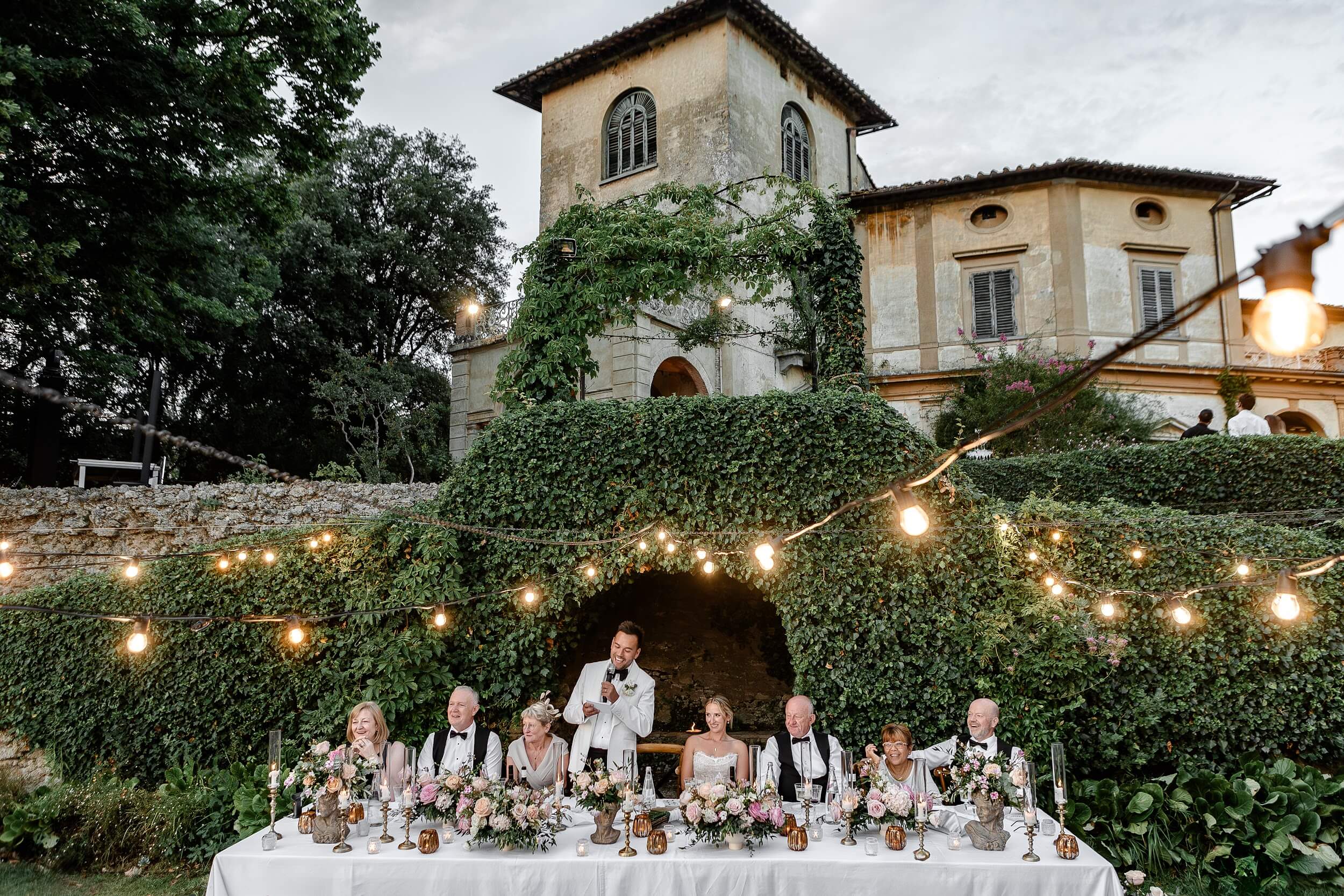
Incorporating a few Italian words or phrases into your toast is a beautiful way to honour the setting and connect with the local spirit. Hearing guests cheer “Evviva gli sposi!” adds a burst of joy and unmistakable Italian spirit to the moment — a simple expression that fills the celebration with warmth and togetherness.
Then there are the micro-rituals that give Italian weddings their poetic touch. Among them, the bomboniera — a small gift offered to guests at the end of the reception — holds deep meaning. Inside are five sugared almonds, known as confetti, symbolising health, wealth, happiness, fertility, and longevity. Their sweetness carries the hope of a life that is rich, balanced, and shared — a simple yet meaningful way to honour the joys of marriage.
For international couples, offering guests a reinterpreted version of the bomboniera — perhaps handmade chocolates, olive oil from the region, or a keepsake crafted by local artisans — can become a thoughtful nod to Italian culture and craftsmanship.

One of the most joyful moments in any Italian wedding is when the newlyweds step outside the ceremony, greeted by friends and family ready to toss rice into the air. This ancient gesture, rooted in Roman tradition, symbolises fertility, prosperity, and abundance — the hope that the couple’s new life will be rich in both love and good fortune.
The grains of rice, light yet full of meaning, fall over the couple like a gentle blessing, marking the joyful passage from ceremony to celebration.
Today, this ritual is often reimagined in a more sustainable or creative way. Many couples replace rice with olive leaves, flower petals, lavender, or even dried herbs from the region, keeping the symbolism of abundance while embracing local textures and scents.
Whatever the choice, what matters most is the shared joy of that instant — a spontaneous, heartfelt explosion of happiness. Italians often accompany it with a single word that says it all: “Auguri!” — good wishes! — a wish that carries the warmth of tradition and the lightness of new beginnings.
Understanding these small traditions gives you more than cultural awareness; it offers a way to make your wedding truly part of the place that hosts it — not just set in Italy, but subtly shaped by its essence.

The Groom Dress Code in Italy
Italian style is not about extravagance — it’s about balance, proportion, and a self-confidence. Nowhere is this more visible than in the way Italian men dress for formal occasions. For a groom choosing to marry in Italy, understanding the Italian dress code isn’t just about appearance; it’s about embracing a cultural language made of elegance, precision, and respect for the moment.
The Italian approach to wedding attire is guided by a sense of harmony with time and place.
In the morning or early afternoon, the classic choice is a dark suit or the elegant morning coat (tight) — perfect for a church or formal villa ceremony. As the day turns to evening, etiquette leans towards the tuxedo or smoking, reserved for black-tie receptions or refined celebrations under the stars. The rule is simple yet timeless: let the hour of the day set the tone for what you wear.
Colour, too, carries its own significance. Italian grooms tend to favour deep navy, charcoal, or midnight blue, tones that remain elegant under any light. Lighter shades — stone, ivory, or dove grey — find their place in summer weddings, especially in countryside or coastal settings where natural light softens every contrast.
More than a question of colour, though, it’s about texture and fabric. The Italian climate rewards intelligence: lightweight wool, linen blends, and silk details ensure comfort even in the Mediterranean heat, while maintaining the crisp lines that Italian tailoring is known for.

Formal or Country Style: Reading the Setting
In Italy, the choice of attire is deeply connected to the style of the wedding. A celebration in a historic villa or castle calls for refined formality — structured fabrics, polished shoes, a discreet boutonnière, perhaps even a waistcoat or a pocket watch. The tone is one of classic elegance, in harmony with marble halls, candlelight, and string quartets.
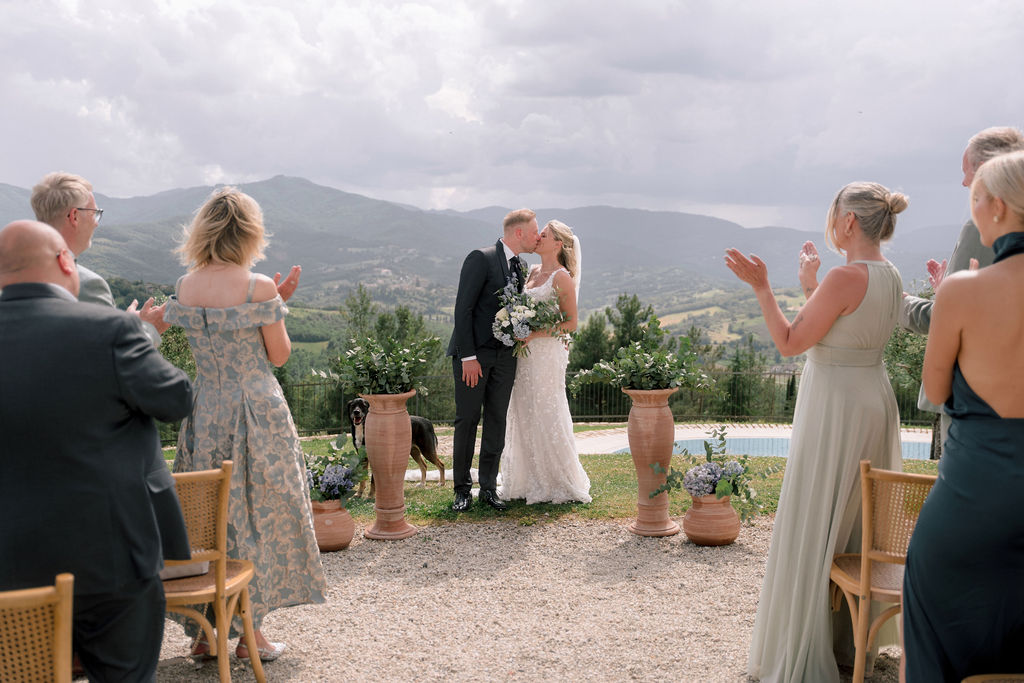
By contrast, a wedding set in the Tuscan countryside, surrounded by vineyards or olive groves, invites a softer and more relaxed aesthetic. Here, natural fabrics like linen or cotton-linen blends, lighter colours, and unstructured jackets feel authentic and appropriate. The look remains elegant but breathes with the landscape — polished yet effortless, formal enough to honour the occasion but never out of place under open skies.

In both cases, the essence lies in coherence. Italian elegance is never forced: it’s about feeling in tune with your surroundings. A formal villa celebration and a rustic vineyard dinner may share the same refinement, yet they speak different visual languages — one tailored and architectural, the other natural and free-flowing. The key is to listen to the venue, to the season, to the light, and let your attire reflect the atmosphere you’ve chosen to live in.
No detail is accidental. The boutonnière — a single, fresh bloom, never a bulky cluster — is worn as a small tribute to the wedding’s floral palette. Shoes are polished but understated, the tie chosen for texture rather than pattern, and the fit… always precise. In Italy, a good tailor is as essential as the suit itself. A well-cut garment expresses respect: for the event, for tradition, and for oneself.
But elegance in Italy goes beyond clothing. It’s a way of being — an ease that comes from feeling aligned with the setting. That’s why the idea of la bella figura — literally “the beautiful figure” — resonates so deeply. It doesn’t mean vanity; it means being your best self in a way that honours those around you. A groom who arrives composed, at ease, and attentive to detail embodies the essence of Italian style more than any label ever could.

A Matter of Place: Style by Region
Italy’s diversity offers endless inspiration for the groom’s look.
In the Tuscan and Umbrian countryside, the aesthetic blends warmth with refinement — linen, natural tones, and tailored simplicity are the hallmarks of an elegant country chic wedding.
On the Amalfi Coast, the mood becomes lighter, Mediterranean, and radiant: suits in soft shades, perhaps with an open collar for seaside receptions, capture the sunlit ease of the South.
By contrast, a ceremony in a refined venue, like a Villa on Lake Como or a Palazzo in Venice, calls for polished formality — darker tones, fine tailoring, and timeless accessories.
Each region tells its own story through light, landscape, and rhythm. Understanding this helps you shape an attire that not only looks beautiful but belongs beautifully to the place.
For destination weddings, this awareness becomes a relevant advantage. Knowing what local etiquette appreciates allows you to choose confidently — whether that means respecting a church’s formality, adapting to a summer sunset in Tuscany, or simply blending your own culture’s elegance with the refinement of Italian design.
The goal is not to look Italian, but to embrace Italy’s idea of beauty: refined, effortless, and respectful of the moment you’re living.
Little Italian Gestures of Love
In Italy, tradition often hides in the smallest gestures.
One of the most romantic of all is the serenata. Once common in Central and Southern Italy, it was the groom’s way of declaring love on the eve of the wedding — arriving under the bride’s window with musicians, family, and friends to serenade her before the big day.
Today, the serenata has become a symbolic gesture: sometimes a private surprise, a few notes played during the rehearsal dinner, or a small concert shared with guests in a candlelit courtyard.
Another delicate Italian tradition is the bouquet delivery. Unlike in many cultures where the bouquet is chosen by the bride herself, in Italy it is often the groom who gifts the bouquet on the morning of the wedding. It’s a gesture of affection, the last gift for his fiancée before becaming husband and wife.
For destination weddings, reinterpreting this act — perhaps with a handwritten note or a single flower delivered before the ceremony — can be a poetic way to blend old Italian charm with personal meaning.
There is also the custom of spending the night before the wedding apart — a ritual that still holds emotional value in Italy. Traditionally, it was believed to bring good fortune and preserve the excitement of seeing each other again at the altar.
Today, many couples choose it simply for its meaning: a final evening of reflection, anticipation, and calm before the celebration begins. That quiet separation becomes a moment of calm anticipation — a pause before the joy, filled with the awareness of what is about to begin.
These gestures are simple, but together they capture something essential: an understanding of love as a dialogue, not a performance. For the groom who chooses Italy, embracing even one of them means participating in the country’s most beautiful secret — that true elegance is always born from emotion.

Conclusion
To marry in Italy is to step into a story. Every gesture, from the testimoni to the clinking of glasses and the tailoring of a suit, speaks of attention to details.
For a groom, learning these Italian wedding traditions is not about following a script. It’s about discovering how elegance can be lived rather than displayed; how respect can be shown through detail; how emotion can be expressed through simplicity.
Knowing them allows you to choose — to decide which gestures to embrace, which moments to reinterpret, and how to let Italy’s sense of elegance shape your own celebration.
A destination wedding in Italy is never just a ceremony or a party. It’s a journey of experience — one that blends beauty, culture, and connection. For both the couple and their guests, it becomes a way of living the country, of touching its essence through taste, sound, and tradition.
That’s why replicating a wedding “as at home” would miss the point: Italy gives you more than a backdrop. It gives you the chance to create something real — something that belongs to the place and to your story at once.
The most meaningful way to honour that opportunity is to know these traditions — not to copy them, but to weave them, with intention, into your own cultural fabric.
When you choose which Italian details to embrace — a toast, a serenata, a simple gesture of elegance — you create a celebration that is deeply personal, yet enriched by the soul of the place.
Only then does a destination wedding become what it is meant to be: an encounter between worlds, a moment where cultures meet, and love finds its most authentic voice.
Explore Dilay & Jonathan’s destination wedding in Italy, a real celebration where their cultural roots blended seamlessly with Italian elegance.
What makes a destination wedding in Italy truly unforgettable isn’t how flawlessly it unfolds, but how honestly it’s lived.
When a couple chooses to blend their own story with Italian traditions, something unique happens: the wedding stops being an event and becomes an experience — personal, meaningful, and deeply connected to its place.
GET IN TOUCH